

Your Sage Intacct reconciliation process probably looks like this: export the trial balance, pull supporting documents, match transactions in a spreadsheet, investigate the variances that don't tie, and document everything by hand. One entity with 50 accounts is manageable. Ten entities with 350 accounts each turns reconciliation into a coordination problem your team can't close in a reasonable window. Reducing reconciliation time for Sage Intacct means changing how the matching and classification work gets done before a human ever opens the review queue.
TLDR:
- Sage Intacct lacks native transaction matching to bank feeds and source documents, leaving teams to export data, match in spreadsheets, and re-enter results manually.
- Multi-entity reconciliation compounds fast: 10 entities with 350 accounts each creates 3,500 individual reconciliations per close cycle with no shared context.
- Teams report spending 15 to 20 hours per close cycle on reconciliation alone, and that number climbs as entity count grows.
- Reducing exception volume from 12 to 15% to 3 to 5% cuts manual review time by widening tolerance thresholds and building period-aware matching rules.
- Truewind automates transaction classification, journal entry preparation, and account-level reconciliation across entities, producing an 80% reduction in reconciliation time.
Why Sage Intacct Reconciliation Takes Longer Than It Should
| Reconciliation Friction Point | Time Impact Per Close Cycle | Where It Compounds |
|---|---|---|
| Manual transaction matching to bank feeds and source documents | Teams export data, match in spreadsheets, and re-enter results each period | Repeats in full for every entity with no shared context between them |
| Exception volume at 12 to 15 percent of total transactions | Senior accountants spend 15 to 20 hours per close on reconciliation work alone | Timing differences, duplicate flags, and missing dimension tags generate manual review queues |
| Multi-entity reconciliation with no parallel processing | Ten entities with 350 accounts each creates 3,500 individual reconciliations per cycle | Each entity requires sequential pull, match, and document steps with coordinator handoffs |
| Variance investigation without automated root-cause analysis | Every unmatched line requires manual lookup, judgment call, and documentation | Fatigue and volume pressure increase missed variances that surface during audit |
Sage Intacct gives you a solid GL, but the reconciliation workflow still depends heavily on manual steps that compound across entities, accounts, and periods.

The core friction points are structural:
- Sage Intacct stores transaction data at the GL level, but matching that data to source documents, bank feeds, and subledgers still requires your team to pull reports, open supporting files, and work through discrepancies by hand.
- Multi-entity close multiplies the problem. Each entity carries its own account set, and there is no native mechanism to run reconciliations in parallel across all of them.
- Exception handling stays manual. When a balance doesn't tie, the investigation process, finding the source, determining the cause, and documenting the resolution, runs on spreadsheets and email threads.
The result is that reconciliation time scales with volume in a way that is hard to contain without changing how the work gets done.
Sage Intacct's Native Reconciliation Capabilities and Limitations
Sage Intacct handles the GL side of reconciliation well. You can tie out balances, run reports, and post journal entries without leaving the system. For teams managing a handful of entities with clean transaction data, that's often enough. Account reconciliation best practices focus on comparing internal ledgers against external statements, but the execution layer still requires manual coordination.
The friction shows up at scale. Sage Intacct stores what happened in the GL, but it doesn't automatically match transactions to source documents, flag unexplained variances, or draft the supporting workpapers your auditors expect. That work still falls to your team.
Where the Native Workflow Breaks Down
Three specific gaps account for most of the added hours:
- Transaction matching is manual. Sage Intacct doesn't pull in bank feeds, payout statements, or third-party source files and match them to GL entries on its own. Your team exports data, works the matching in spreadsheets, and then re-enters the results.
- Variance explanations don't write themselves. When a balance doesn't tie, Sage Intacct surfaces the number but not the reason. Building the narrative for each unexplained line is entirely manual work.
- Multi-entity volume multiplies fast. One reconciliation per month is manageable. Across 50 or 100 entities, the same manual steps repeat in full for each one, with no shared context between them.
None of these are design flaws. Sage Intacct is a GL, and a good one. The gaps are in the execution layer that sits between the raw GL data and a reviewed, audit-ready close package.
The Real Cost of Manual Reconciliation Work
Manual reconciliation in Sage Intacct drains more time than most teams track. Accountants report spending 15 to 20 hours per close cycle on reconciliation work alone, and that number climbs fast as entity count grows.
The problem compounds at the transaction level. Every line item without a match requires a manual lookup, a judgment call, and a note. Multiply that across hundreds of accounts and the first week of close becomes categorization work, not review work.
There is also a quality cost. Fatigue and volume pressure increase the chance of missed variances, and those misses tend to surface at the worst possible time.
How Rule-Based Matching Actually Works in Sage Intacct
Sage Intacct's matching engine works by comparing transaction records against rules you define manually. You set conditions, field values, and tolerances, and the system flags records that meet those criteria as matched.
The catch is that every rule has to be built by hand. Your team writes the logic, tests it against historical data, and updates it when the business changes. A new vendor, a renamed cost center, or a format shift in your bank feed can break existing rules without warning.
Where Manual Rule Sets Hit Limits
Three failure points show up consistently:
- Rules only catch what you anticipated. Any transaction that falls outside a predefined pattern lands in an exception queue for manual review, which means the volume of exceptions rarely drops as fast as teams expect.
- Rule maintenance compounds over time. Each new entity, dimension, or account type requires additional logic. At 50 entities or more, maintaining that rule library becomes a recurring burden.
- Matching confidence is binary. A rule either fires or it does not. There is no graduated confidence score, no contextual reasoning, and no way for the system to learn from how your reviewers handle exceptions.
The result is a ceiling: rule-based matching can reduce reconciliation time, but it cannot adapt on its own.
Multi-Entity and Multi-Account Reconciliation Challenges
For teams managing multiple entities, reconciliation time compounds fast. One entity with 50 accounts is manageable. Ten entities with 350 accounts each means 3,500 individual reconciliations per close cycle, and that math doesn't include intercompany eliminations, dimension-level reporting across classes and departments, or the coordination overhead of getting every sub-entity's books closed in sequence. Multi-entity accounting complexity scales with every entity added through growth or acquisition.
Sage Intacct handles multi-entity consolidation well at the GL layer. What it doesn't do is automate the reconciliation work inside each entity. Each account still needs a human to pull the supporting detail, match it to the GL balance, and document the tie-out. Multiply that by entity count and account volume, and the close stops being a workflow and starts being a staffing problem.
Where the time actually goes
Three areas account for the bulk of multi-entity reconciliation time:
- Pulling and formatting support for each account across each entity, which means going through Sage's reporting layer repeatedly instead of working from a single consolidated view.
- Chasing intercompany balances that don't agree, which requires cross-entity coordination and often manual journal entry corrections before the reconciliation can close.
- Re-doing work when an upstream entry changes late in the cycle, because a posted adjustment in one entity can ripple into accounts you already signed off on.
The challenge scales with entity count. A two-entity close is inconvenient. A 20-entity close with shared services, intercompany loans, and dimension-level reporting is a different problem entirely.
Brokerage and Investment Account Reconciliation Gaps
Sage Intacct's native reconciliation tools work well for straightforward bank and credit card accounts. Brokerage and investment accounts are a different story.
These accounts generate transactions that don't map cleanly to a single GL line: dividend reinvestments, unrealized gain/loss entries, fee accruals, and split lots all require matching logic that goes beyond what Sage's standard bank feed and matching rules handle. Teams end up pulling custodian statements manually, building spreadsheet bridges, and posting journal entries by hand each period.
The gap shows up in a few specific places:
- Custodian statement formats vary by institution, so there's no consistent import path into Sage. Each period, someone maps columns, checks totals, and reconciles the difference by hand.
- Unrealized gain/loss positions update daily but only need to hit the GL at period end. Tracking the delta between Sage and the custodian's reported fair value requires a separate workpaper that most teams maintain outside the system.
- Multi-lot positions with partial sales require average-cost or specific-identification calculations that Sage doesn't perform natively, leaving the cost basis math to whoever owns the schedule.
For teams managing a single investment account, this is a manageable annoyance. For family offices or fund administrators tracking dozens of positions across multiple entities, the manual work compounds fast.
Building a Transaction Classification Layer Before Reconciliation
When transactions hit your GL already coded correctly, reconciliation shrinks to exception handling. The classification step is where most of the time goes, and it compounds fast across entities.
Sage Intacct stores transaction data at the dimension level, which means a single miscoded entry can misalign across class, department, location, and project simultaneously. Fixing one line is rarely fixing one thing.
What a Classification Layer Actually Does
A classification layer sits between your source transactions and your GL, applying learned coding rules before entries post. Instead of reviewing everything, your team reviews only what the layer flags as uncertain.
- Rules built from historical GL data catch recurring vendors, amounts, and patterns without manual input each period.
- Exceptions route to a queue instead of a spreadsheet, so senior accountants spend time on the 5% that needs judgment, not the 95% that doesn't.
- Dimension alignment gets enforced at the point of classification, not identified during tie-out.
The result is that reconciliation starts with a cleaner trial balance. Variance investigation drops because fewer variances exist to investigate.
Exception Handling: Reducing the Volume of Items Requiring Manual Review
Most reconciliation delays don't come from the matching itself. They come from the tail: the 5 to 15% of transactions that don't match automatically and pile up in a queue your team has to work through manually.
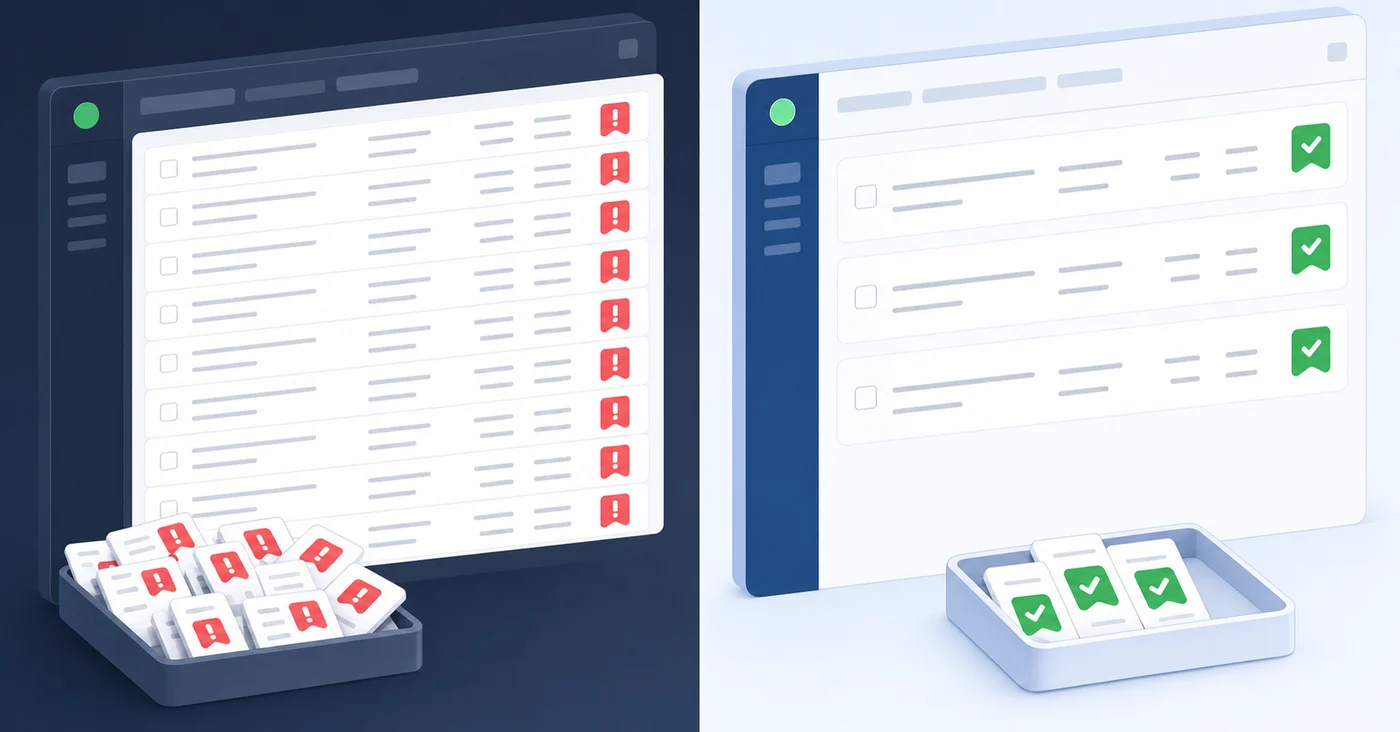
Reducing that queue is where the real time savings live.
What Drives High Exception Volume
A few patterns account for most of the manual review burden in Sage Intacct environments:
- Timing differences where a payment posts in one period and the corresponding invoice clears in another, generating a mismatch that isn't actually an error
- Duplicate transaction flags triggered by similar amounts or vendors, requiring a human to confirm whether the duplication is real
- Missing dimension tags (class, department, location, project) that prevent automatic matching rules from firing in the first place
- Threshold-based tolerances set too tightly, flagging immaterial variances that add queue volume without adding close quality
How to Shrink the Queue Before It Starts
Adjusting your matching logic upstream cuts exception volume more than any review workflow change will. Widen tolerance thresholds to a defensible materiality level. Build period-aware matching rules that account for timing differences by design. Audit your dimension tagging at the source so transactions arrive in Sage with the metadata your rules require.
Teams that do this consistently report moving from a 12 to 15% exception rate down to 3 to 5%, which translates directly to fewer hours spent on manual review each close cycle.
Workflow Orchestration: Connecting Reconciliation to Month-End Close
Reconciliation speed only converts to close speed when the rest of the workflow moves with it. Finishing account reconciliations early matters only if variance review and journal entry sign-off keep pace. Truewind connects these steps by routing completed reconciliations into flux analysis and flagging accounts that need a journal entry before the trial balance ties.
How the handoff works in practice
When a reconciliation closes in Sage Intacct, Truewind reads the ending balance and compares it against the prior period. Accounts outside your defined variance threshold get queued for review automatically. Your team sees the exception, not the full account population.
- Variance flags surface at the reconciliation level, so reviewers go straight to the accounts that need attention instead of scanning the full trial balance for anomalies.
- Journal entry preparation runs in parallel with reconciliation review, so entries are staged and ready for posting by the time sign-off happens.
- Close task status updates in real time across the team, so no one is waiting on a status email to know what still needs to move .
The result is a close where reconciliation, flux review, and journal entry posting run as one connected sequence instead of three handoffs managed over email and spreadsheets.
How Truewind Reduces Reconciliation Time by 80% for Sage Intacct Users
Truewind connects to Sage Intacct via API and automates the work that typically fills the first week of close: transaction classification, journal entry preparation, and account-level reconciliation across every entity.
When Truewind reads your GL on connection, it learns your historical coding patterns. A $300 United charge codes to travel. A recurring SaaS invoice maps to the right prepaid schedule. That context carries forward so your team stops making the same judgment calls on the same transactions every month.
Truewind customers report up to an 80% reduction in reconciliation time for Sage Intacct users.
What Gets Automated
- Transaction classification runs against your existing GL history, so entries arrive pre-coded to the right account, class, department, and location before a reviewer ever opens the queue.
- Journal entry preparation covers standard monthly entries: prepaids, accruals, deferred revenue, and fixed asset rollforwards. Truewind generates the GL-ready entries; your team reviews and posts.
- Account reconciliation across entities runs in parallel rather than sequentially. Multi-entity closes that previously required a coordinator to manage handoffs now resolve in a fraction of the time.
Your team owns every final posting decision. Truewind handles the preparation work that was consuming senior accountant hours.
Final Thoughts on Faster Reconciliation in Sage Intacct
Reconciliation delays don't come from matching transactions. They come from the tail: exceptions that queue up, timing differences that need manual investigation, and classification work that repeats every month. When that prep layer runs automatically, your close becomes a review process instead of a categorization marathon. The question is whether your team can continue to scale reconciliation work linearly with entity count, or whether the prep layer needs to run differently.
FAQ
How do you reduce reconciliation time using AI in Sage Intacct?
AI learns your historical GL coding patterns and applies them to new transactions before they post, so entries arrive pre-coded to the right account, class, department, and location. Your team reviews only the 3–5% flagged as uncertain instead of manually categorizing the full transaction population.
Can I automate Sage Intacct reconciliation without replacing my GL?
Yes. Truewind connects to Sage Intacct via API and automates transaction classification, account reconciliation, and journal entry preparation while keeping Sage as your system of record. Your GL stays in place; the automation layer sits on top.
How do multi-entity reconciliations work faster with automation?
Automation runs reconciliations in parallel across all entities instead of sequentially, and applies learned coding rules across the entire entity set with shared context. Teams managing 50+ entities report moving from 15 to 20 hours per close cycle down to 3 to 4 hours.
What causes high exception volume in Sage Intacct reconciliations?
Timing differences between payment and invoice clearing, duplicate transaction flags on similar amounts, missing dimension tags that prevent rule matching, and tolerance thresholds set too tightly all generate manual review queues. Widening thresholds to a defensible materiality level and building period-aware matching rules cuts exception rates from 12–15% to 3–5%.
How does AI-powered invoice reconciliation work in practice?
The system matches bank deposits to payout statements and invoices by comparing transaction attributes against historical patterns, then routes items with no match into an exception queue for review. Your team handles only the variances that require judgment, not the full match workload.
Turn this into a close-ready workpaper
Start with sample files or upload your own statements to see how Truewind prepares review-ready workpapers and journal entries.